

A note to art museum executives who take cultural communication seriously.
Taiwanese people are rich. The Taiwan Stock Exchange is currently racing to claim sixth place worldwide by market capitalisation [1] — and Taiwan is an island of just 23 million people. Let that sink in for a moment. A population smaller than Australia’s, generating one of the largest equity markets on earth. Evidently, Taiwanese are rich. And we do not stay home.
In 2023 alone, nearly 12 million Taiwanese — more than half the entire population — travelled abroad. The country’s outbound tourism deficit hit a record TW$738 billion in 2024, which is to say: Taiwanese are spending enormous sums of money in other people’s countries. Per outbound traveller, that is approximately US$1,763 on average — and that figure does not capture the full picture of what a culturally engaged, high-spending Taiwanese visitor brings to a city.
We love to travel. More specifically, we love to travel well. Japan, Europe, the United States — Taiwanese tourists are everywhere, and we are not sitting in hotel rooms. A quarter of Taiwanese visitors to the United States reported visiting art galleries or museums during their trip. That is not a niche interest. That is a measurable, recurring audience walking through your doors.
We Are Already at the Louvre. Are You Ready for Us?
The Musée du Louvre welcomed 8.9 million visitors in 2023 and 8.7 million in 2024. Seventy-seven percent of those visitors were international [2] — over six million people who made a deliberate journey to stand in front of the Winged Victory of Samothrace or the Venus de Milo. The British Museum drew close to six million visitors in 2023 alone. MoMA sees nearly three million a year.
Taiwanese visitors are part of this footfall. We are there — in the queues, in the gift shops, in the café, in the permanent collection and the special exhibitions. We plan our trips around cultural itineraries. We share our visits on social media to audiences who then plan their own. We are not passive tourists; we are active cultural consumers, and we are, by any meaningful measure, affluent ones.
The question is not whether Taiwanese visitors are coming to your museum. They are. The question is whether your institution is meeting them with any degree of intention — or whether you are still serving them a Simplified Chinese page and hoping for the best.
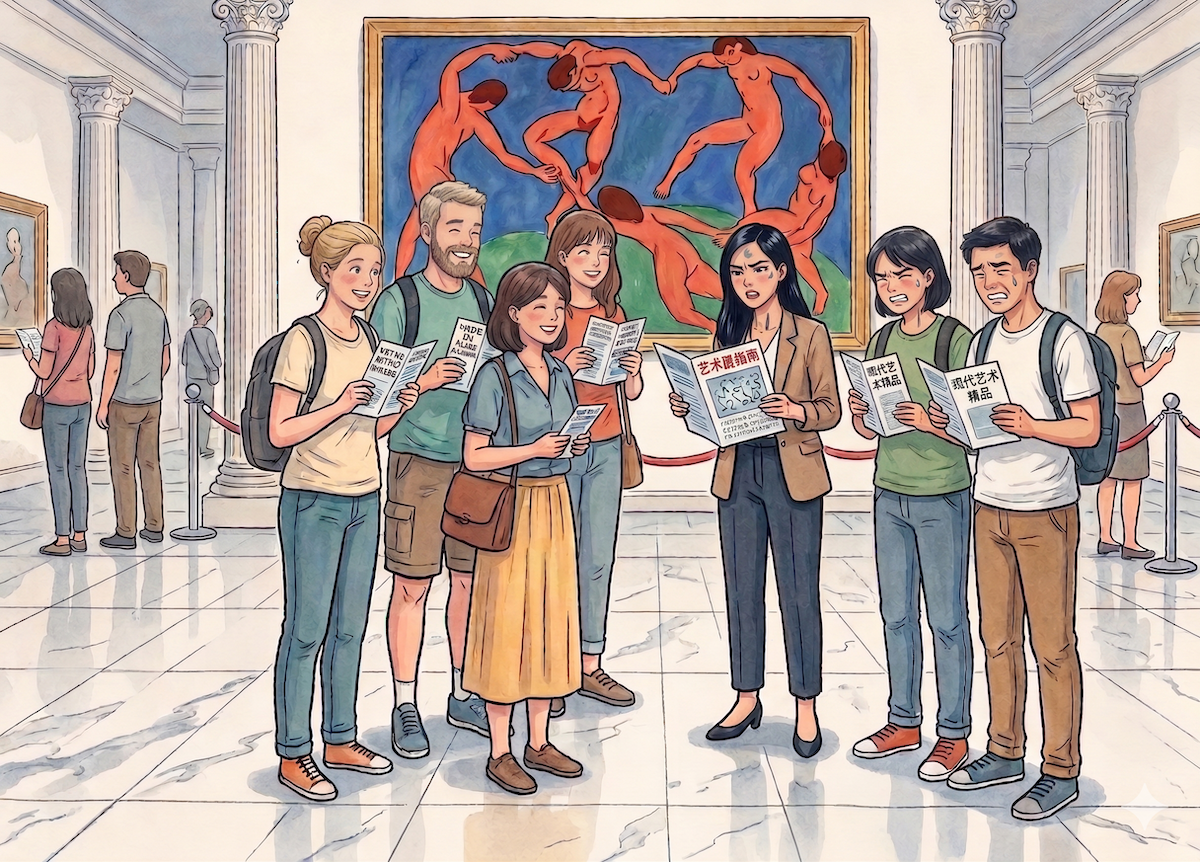
In Taiwan and Hong Kong, we use Traditional Chinese (正體中文).
Traditional Chinese Is Not a Dialect. It Is a Different World.
Here is where most Western institutions get it wrong, and it costs them.
While this distinction may already be on your radar, it’s worth reiterating: both Taiwan and Hong Kong use Traditional Chinese, a writing system with its own cultural and historical significance, rather than Simplified Chinese. Recognising that difference is a small but meaningful step towards more thoughtful audience engagement.
Simplified Chinese was a script invented by the People’s Republic of China — introduced in the 1950s and 1960s as a political and literacy project, deliberately reducing the complexity of characters to increase mass legibility.
The differences between the two are not merely cosmetic. They are not like American versus British spelling, where you swap a few letters and everyone is fine. Simplified and Traditional Chinese diverge in character form, vocabulary, grammar patterns, and — critically — cultural register. A Taiwanese reader encountering Simplified Chinese text does not feel welcomed. They feel addressed wrongly, the way you might feel if a restaurant handed you a menu in a language you technically understand but that signals, unmistakably, that you were not who they had in mind.
But there is a deeper issue than legibility. There is the matter of what these two scripts represent.
The Cultural Revolution Buried What Taiwan Preserved
In 1966, the People’s Republic of China launched the Cultural Revolution. Over the decade that followed, an extraordinary assault on Chinese cultural heritage took place: temples destroyed, classical texts denounced, artefacts smashed, scholars persecuted. The explicit aim was to sever China’s relationship with its own past — to create a new culture untethered from thousands of years of civilisation.
Taiwan went the other direction.
When the Nationalist government (國民政府) retreated to Taiwan in 1949, they brought with them a significant portion of the imperial collections — treasures from the Forbidden City, artefacts of staggering historical and artistic significance. These are now housed in the National Palace Museum (國立故宮博物院, and btw, it is also one of my clients) in Taipei, which holds one of the largest and finest collections of Chinese cultural artefacts anywhere in the world. More artefacts than Beijing’s Palace Museum can display. More continuity, arguably, with the full depth of Chinese civilisation.
Taiwanese people did not just keep Traditional Chinese characters. We kept the culture that those characters carry — the classical literature, the philosophical traditions, the ritual forms, the aesthetic sensibility that the script embodies while we innovate and embrace progressive values.
Traditional Chinese is not simply older. It is denser, more nuanced, more layered with historical meaning. The characters themselves are a form of cultural memory. Stripping them down, as Simplified Chinese does, is not merely a typographic choice. It was, in its original context, an ideological one.
So when a Taiwanese visitor picks up your museum audio guide and finds only Simplified Chinese — or worse, no Chinese at all — they are not experiencing a minor inconvenience. They are noticing that your institution, for all its claims to cultural sensitivity, has not thought carefully about who they are.
What This Means for Your Institution
If you run a major museum in New York, Paris, London, Amsterdam, Berlin, Vienna, or any other city that draws international cultural tourism, the business case here is not complicated.
Taiwanese visitors are numerous, well-travelled, high-spending, and culturally motivated. They are precisely the audience that museums are built to serve. And they use Traditional Chinese — not Simplified — as their written language of daily life, education, and cultural participation.
A Traditional Chinese version of your website is not a courtesy. It is a conversion tool. It signals that you know who your audience is. It removes friction in planning visits, understanding ticketing, reading about exhibitions, and — yes — making purchases in your online shop and booking memberships. A visitor who navigates your site comfortably in their own script is more likely to arrive prepared, to stay longer, and to return.
There are 17.5 million Taiwanese outbound trips estimated for 2024 alone. Many of those travellers are heading to the same cities where your museum sits. They have disposable income, a genuine appetite for arts and culture, and a sophisticated awareness of institutions that take them seriously versus those that do not.
The ones that do not — they notice.
Looking to better serve Traditional Chinese audiences in your next international art project? Get in touch today.
Rye Lin is an English-Chinese interpreter, translator, and cultural consultant based in Taipei. She works across English, Chinese (Mandarin, Cantonese) ,and Taiwanese with a particular interest in arts, heritage, and the cultural blind spots that institutions create when they assume all Chinese audiences are the same.

[1] https://economictimes.indiatimes.com/markets/stocks/news/taiwan-overtakes-canada-to-become-6th-largest-stock-market-as-ai-demand-lifts-tsmc-m-cap-to-1-8-trillion/articleshow/130596363.cms?from=mdr#google_vignette
[2] https://presse.louvre.fr/8-7-million-visitors-to-the-louvre-in-2024/?lang=en